Today let us talk about a piece I am so glad and ecstatic to own.
It is a Tissot PRX Triple Pointer Date Moon phase R80 quartz watch , with is a Swiss made chronometer in stainless with gold tone bezel and day date.
I have been finding or trying to get my hands on a vintage moon phase timepiece.
I am glad to announce, I now finally have it.
Though it may not be that old, it is still a 26 year old piece in good working condition.
What makes it all the more special is that, I received confirmation from Tissot on this piece.
At first I was a rather sceptical, as little or close to no info was available online for this particular piece.
There were many PRX models but one with moon phase seemed almost impossible to find any information.
I wished to be able to have more info on this lovely looking piece, to understand its history more.
Unfortunately I really could not find anything online or anywhere else to help ease my queries.
As of now, all I got are little bits and pieces from here and there.
Though I am thankful to have a valuable source of information directly from Tissot.
Their reply to my enquiry gave some basic info on my timepiece.
Below is a response I got from Tissot in Switzerland,
“
We can inform you that this model PRX is a Tissot production from 1989.
The watch is fitted with a quartz movement, and is 10 bar (100 meters) water resistant.
The case are made of PVD/steel. This model was also available with gilt, white or black dial.
”
Though I can only think of one set back, which is that the watch size is a little small but this was the case for timepieces made back in the day up till the 90s.
So unlike the big watch faces we are used to seeing these days or the heavy size, back then it was somewhat petite.
Personally gold coloured moon phase watches looks a tad more classy and gives it a luxurious feel.
To further break down this timepieces below are its specs;
Tissot PRX - Quart 7 jewel Swiss movement.
Dual tone colour combination “18K Gold electro plated and Steel”
White dial with three sub dial indicator column for “Month, Day and Moon phase”.
The second hand sub-dial located at moon phase, while the long needle with a tip resembling a red crescent is a hand pointer date, date version of the circular dial.
Index Strip hours marker.
Solid SS bracelet with a variant of the gold-steel tonnage segment.
Three folding clasp.
WR100m, scratch-resistant glass (sapphire crystal).
36mm diameter crown. 7mm thickness.
Fixed bezel ring pattern formation 12 angle.
If anyone out there has more info on this lovely timepiece, I am all ears!
Showing posts with label types of watches. Show all posts
Tuesday, December 29, 2015
Wednesday, June 3, 2015
Seiko Criteria, Chronograph.
Seiko almost wiped off the existence of automatic watches back in the day. Aptly known as the ‘Quartz Crisis’ in Switzerland and the ‘Quartz Revolution’ outside of Switzerland. The invention of the Seiko Quartz watch changed watch history forever in terms of Horology. The world’s first quartz watch was released by Seiko, call the Quartz ASTRON.
From then on Seiko has never looked back, developing so many other interesting timepieces like the Seiko Kinetic as well.
Today I won’t go into deal on how fantastic Seiko has been over the years.
I am going to talk about a Seiko I own. So this is my first ever Seiko. A Seiko is somewhat a watch for the everyday man and here in Singapore I see a Seiko or Citizen on the wrist on the average man on the street. Well growing up no one in my family really cared much about timepieces and we had really basic watches on our wrist, just to tell the time. The first ever watch I had as a kid was probably a digital Casio watch.
Well since then, I have come a long way. I have had a deep interest in Horology and in the arts of fine watch making. Though Seiko may not fall into the category of fine watch making. It definitely deserves a place in Horology history for their contributions to the Horological world.
The watch at hand is the limited edition Seiko Criteria SNDG13P1, number 2041 out of 3600.
Below are the specifications of this timepiece

On the bezel there are Arabic markings and seconds hands in multiple of fives.
Inside on the dial there are more markings for the Tachymeter function.
This is a nice weighty piece, as for me I like big heavy pieces that has a little more weight on the wrist.
The steel bracelet does surely add more weight on this piece. Making it a little bulky and stand out slightly more.
So overall this is a nice piece with great chronograph and
tachymeter functions.
With stark colours to make it shine, it has a nice sporty feel like an aviator or motor GP watch.
This can be worn both with your suit to work or for a game of golf.
Take a look and judge for yourself.
Tuesday, February 24, 2015
My frist Swiss Timepiece & what is GMT
The first Swiss timepiece I got was a Cyma, it was a world time GMT in rose gold.
Just to share something on Cyma, so the back story of Cyma (in French meaning Summit) watches, is that it was founded by brothers Joseph and Theodore Schwob in 1862. By the 1920s, Cyma’s strategy or route was inclined to standardise watch part manufacture. For Cyma producing average parts wasn’t good enough. Precision was paramount to ensure long term accuracy. Though there was magnificent accuracy, it wasn't all that study and these wasn't something faced only by Cyma. Despite all these efforts, early timepieces were known to be vulnerable to damage when impacted upon. Till there was a breakthrough technolody. A reliable and fantastic shock proofing system being used in 1930s, invented by Georges Braunschweig and Fritz Marti. From this creation it led to an in-house revolution by Cyma, in the 1950s, it developed its own shockproofing system known as Cymerflex. This is a true testament of Cyma’s pinnacle, sort of reaching its “Summit”. Thus till today, you hardly ever hear of a Cyma of the yesteryears giving you much trouble.
Today, having spoken to so numberous people it seems the name Cyma is somewhat a forgotten thing of the past. In recent times, its prestige and presence has dwindled down over the years from the way I see it and am not entirely sure why so as well.
On to my first Swiss timepiece, it is a GMT World Time (pictures below).
It is a quartz movment, a beauty to behold, aesthetically to me it is lovely and classy. So after getting my hands on my timepiece, I had to figure out how exactly does one read the time on a GMT watch. So here I will try explain what exactly is a GMT watch and how it functions in lay man’s terms.
Firstly, “GMT” stands for Greenwich Mean Time and is the zero point on the 24 hour scale of international time zones. Greenwich is in England, and from there other time zones are plus or minus GMT. This was set in place so that travellers could tell time of the location they are in, where ever in the world. As long they knew the GMT time, they could then add or subtract from that time to get the local time or somewhere else. Point to note, GMT is also known as UTC ( Coordinated Universal Time), this may be a common sight in German timepieces.
Most GMT timepieces have two hands to display both the time in a 12-hour format and an independently adjustable 24-hour hand. If the 24-hour hand cannot be adjusted independently, its only purpose then is to solely indicate if the time is AM or PM. One of the primary reasons a GMT timepiece is used so that people can tell the local time along with other time zone that is not usually GMT. So this helps to tell the time in any two different time zone, which may be locally or internationally and doesn’t not have to be GMT.
Once you have accustomed yourself to reading two different time zone, since most GMT timepieces have a rotating 24 hour bezel (if a GMT scale is available on the dial) you can use it to follow a third time zone. Though this may need some calculations.
So basically a GMT timepiece shows you 2 times zone at the same time. This may be the second most handy complication out there in next to a chronograph. Or even the second most common?
Sunday, January 25, 2015
Hugo Boss Timepieces
So I recently received a Hugo Boss Timepiece as a gift. I
have been scratching my head to figure out where exactly the watch is made in?
Nowhere on the box, manual guide or watch does it state. I
have not tried opening the backing of the watch, as I do not have the proper
tools nor expertise for it.
I have a few pictures below of the watch I received, let’s
see if any ne out there can help me out on this.
I have been doing some reading online, what I found out is that Hugo Boss has licensing agreements with Movado to help produce timepieces for them. This is the background except from Wikipedia, “ The brand's parent company, Movado Group, Inc., was founded in Switzerland in 1983 by Cuban-born Gedalio Grinberg. The company designs, manufactures, and distributes the following brands of watches in addition to its own: Ebel , Concord, ESQ Movado, Coach, Hugo Boss, Lacoste, Juicy Couture and Tommy Hilfiger.
Of all the above brands, I only know Concord watches to
fetch a hefty price tag. None of the other brands, like Ebel the principal brand
of Movado have I really heard much of. Prior to this, I must admit I did think
of Concord watches to be altogether an independent brand. I can’t seem to find
a reference, link or connection on Concord’s website www.concord.ch tying it up with Movado. I
guess this could be a marketing strategy, to make it seem like a totally
independent brand from Movado. As who would want to spend 50 grand on a timepiece
(Yes, I personally know someone who bought a Concord timepiece for 57Grand) to
having later find out, that the watch they pay such dough for is linked to a
company making “mediocre” timepieces for Fashion Label, who are finding
secondary means to generate more revenue. On the other hand, some people may
not even bother about such trivial things. Thought I can see myself being one
of the lesser few who may be. After some
searching I did find it stated on Mavado’s website; http://www.movadogroup.com/brands/concord.cfm
While scavenging through some forums, some signs points to perhaps
the Hugo Boss watch I received could have possibly be made and assembled in
China. Which would be no surprise for me, but I don’t seem to be able to find
any solid evidence for it.
Movado may be a Swiss company but I am pretty sure the
watches under their account from Coach, Hugo Boss, Lacoste, Juicy Couture and Tommy Hilfiger
are surely not Swiss made as it would surely add additional ‘zeros’ or well at
least hundreds to the price tag to be modest. Also the most clearest indication
would be to slap on the ‘Swiss made’ tag on the dial, which who wouldn’t right?
On the other hand, some people in forums said they may actually be made in Germany. Though at this point of time, I have
no actual evidence of this. Having read several forums, many other people seem
as puzzled as myself.
So
this still have left me scratching my head. Never thought finding something
like this out could be so tedious. It all seems a little jiggery-pokery.
Labels:
chronograph,
chronometer,
chronos,
concord,
hobby,
hugo boss,
interest,
joy,
mechanical,
movado,
movements,
passion,
timepieces,
timer,
types of watches,
watch hobby,
watches,
wristwatch
Friday, January 16, 2015
What is a Chronograph?
So have you ever asked this question, what exactly is a
Chronograph watch?
It may seem like a really absurd question to most
people who know a thing or two about watches.
But guess what, I have been asked this question before. So
why not explain it?
Firstly, before I carry on, yes I do know there are a ton of
websites and books out there that already explain or give you the answer you are
looking for with regards to “what is chronograph or tachymeter” and so on. Well yes
it is true, there are so why exactly am I writing then?
I am doing this to help myself further understand and learn
from what already little or much I may know. As you can never know too much.
Similarly I do live by the principle of, "We learn new things everyday". So writing helps me to learn and express.
Carrying on, so the most basic kind of watches out there are the ones that only show you the time. It has numerals (most of the time, some omit numerals altogether) and 3 hands (Hour, Minute and Second) like shown below.
Before I carry on, we owe it all to Monsieur Louis Moinet,
the inventor of Chronograph. So the back story was that in those days the "aristocrats" were interested in the cosmos, so this invention was actually used for tracking
astronomical objects.
In essence, chronograph
watch is basically a watch that has a stopwatch function added into it.
Chronograph watches can be either automatic or quartz and feature various complications
at once and have several sub dials to read off the measurements. The
most basic chronograph has a separate or independent sweep second hand which
can start and stop, and return to zero. There can be up to four dials on the
face to indicate hour, minute, seconds and 24 hour indicator(some dials show
even up to a tenth of a second), like the Eberhard And Co. Chrono 4 Grande Taille
31052.1 shown below.
Majority of the chronograph's features works by pushing a start button. Usually most of the start
buttons are placed at the Two O Clock position to get the timer moving to record
time and by pressing the same button to stop the time recording and returning
to zero by pressing it over.
Each individual function of the chronograph is independent
of each other. What this means is that your timepiece can tell the time and function
as a stop watch concurrently.
Not to be confused, Chronograph is known as a complication
of a timepiece and not its movement (of the watch).
Just to add in some technical stuff, there are 2 kinds of
chronographs the automatic and digital. Difference being, automatic chronograph
depends only on kinetic energy as a source of its power. The digital on the
other hand works very much like a common hand help stopwatch and is run by batteries.
Wednesday, January 7, 2015
What does a timepiece mean to you?
What does having a timepiece mean? Does a timepiece define a
man or a woman?
Recently I have read some articles on how people have been
discussing on how a timepiece reflects a person’s character or attitude.
Which to a varying degree may seem true but then again some
people have eccentric taste but it may not be a reflection of themselves.
So I just wanted to give my 2 cents worth.
Here goes.
They sometimes say you can differentiate a “ruffian” from
a gentlemen by the watch he wears.
How sophisticated or uncultivated a man may be, is sometimes
measured by his timepiece, how true this is I do not know.
Though it has proved many times more than less, to be true.
Genuine gentlemen, men of chivalry do more often than not have very lovely
timepieces accompanying them on their wrist. Most of these men have timepieces
that are adored by many. Classic, vintage, subtle and never too loud and
flashy. It has the right balance of all things fine.
You see many aristocrats
adorning fine timepieces, many a times a Swiss timepiece. On the other
hand, there are men with money and no appreciation for the finer things in life. Having
money, they may be able to buy many beautiful and expensive things in life, but
that does not simply mean they may understand it or appreciate it. Thus
unfortunately, some men end up buying really flashy expensive timepieces
without having a deep appreciation or understanding of what they own. Many end
up ”bling-ing” up their timepieces. Like having the dial covered in diamonds or a full
diamond bezel. This many a times, diminishes the class of a timepiece in my
opinion. It’s like looking at a Da Vinci painting. It is a masterpiece the
way it is. You would not add anything to it. So why add diamonds all over an already
beautiful timepiece.
Do not get me wrong there are many amazing jewellery
inspired timepieces that have left my jaw hanging. Like those of Cartier, which
has such class and perfection. It has that je ne sais quoi about it that I cannot explain, which is oh so alluring.
Not forgetting many early timepieces by Vacheron Constantin which were actually
made with dual purposes to act as a jewellery piece and to tell them time as well,
like the one below.
MÉTIERS
D'ART LADY KALLA FLAME
(taken from http://www.vacheron-constantin.com/en/watches/metiers-d-art/lady-kalla-flame-17620-s11g-9478.html)
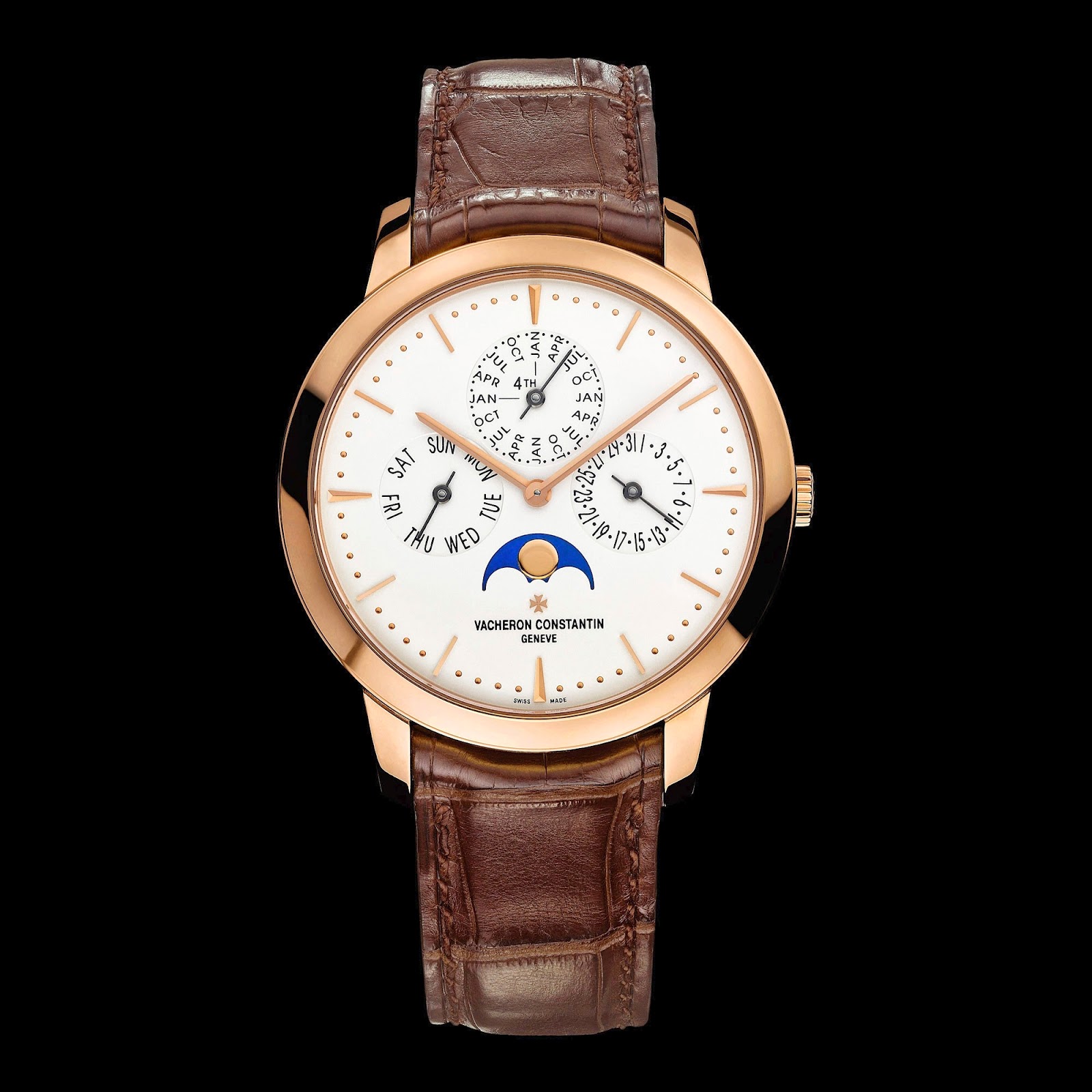
PATRIMONY PERPETUAL
CALENDAR
Though for some reason, I recently laid eyes on a limited edition watch from LIP, and am somehow drawn to it. It is the MACH 1871 to be more specific, this is a really unique timepiece. It is bold, loud and everything I am not usually drawn to. I guess the French have a way to make unconventional seem elegant about it. See the picture below and you will understand what I mean.
So when you
wear a timepiece on your wrist you are showcasing an art form
meant for enjoyment both for your eyes and mine. If at the right place at the
right time, someone who understands what you mean may even start a
conversation, or pay you a compliment on your timepiece. I have read of stories
of how wearing the right timepiece has helped in many situations or even opened
up business opportunities for some.
So keep on
rocking your wrists with any timepiece. Who's to know, it may lead to an open
door for you? I am still awaiting my coveted timepiece to adorn, slowly but
surely I will work my way up to it.
The saying
goes, the pen is mightier than the sword but I beg to differ.
The
timepiece is mightier than both, sword and pen. As history itself proves it. We
see accounts of famous historical figures having owned fascinating
timepieces be it a pocket watch or wrist watch. The likes Napoleon Bonaparte
and Pope Pius XI have adorned a Vacheron Constantin just to name a few.
I find it
rather remarkable that most famous historical figures are associated with timepieces that they had in their possession. It seems that their timepieces
has indeed stood the test of time (pun intended).
So with
that, The pen may be mightier than the sword, but the timepiece conquers all.
Labels:
chronometer,
chronos,
finer things in life,
hobby,
horology,
interest,
love,
mechanical,
stopwatch,
time,
timekeeping,
timepieces,
types of watches,
vacheronconsantin,
watches,
wristwatch
Tuesday, January 6, 2015
So what is Quartz & Mechanical
I have been absorbed into the very
fascinating world of Watches.
I can’t seem to have enough of them,
these fine timepieces have gotten the better of me.
This year I have been reading up
countless pages online on different watch movements and history of certain
timepieces. Expanded my knowledge of many more amazing new and vintage brands.
Learning the differences between
functions and movements.
I still have so much more to learn and
grasp.
The art of watch making is amazing, all
the unbelievable kinds of functions in every time piece, each in its own style
and each brand having it’s open particular speciality.
Firstly a movement is something like
what runs the watch like an engine or heart of the timepiece ( in my own
words).
The most basic being either quartz or
mechanic.
A quartz movement is an electronic
movement. It is called a quartz movement, because a small quartz crystal is
integrated into the electronics. This is done as every timekeeping devices
needs something constant in which it can measure time against. When current is
run through a quartz crystal it will oscillate almost perfectly at a constant
frequency. Hence the reason why quartz watches have such an amazing accuracy.
The better the quartz, the more accurate time keeping will be to within few
seconds a year.
Most quartz watches run on a battery,
which can usually last from 2 to 5 years before a replacement is needed. The
more basic the watch the longer the battery may last. More complicated
movements which may include a compass or stopwatch may result in a shorter
battery life.
Mechanical watches seems like a thing
of the past in our current day and age. Yet it is an important movement as it
may have led to more modern movements. So there may be self-winding or manual
winding mechanical or automatic. The technology used in mechnical watches may
somewhat be centuries old. This movement is powered by springs that turn gears
in which is a regulating mechanism, eventually the hands. Mechanical movements
have a range of 50 to 300 parts. This usually depends on the movement. If
properly maintained and kept in good care, whose to know how long it may last?
From reading maybe articles, it is said
that the jewels used in the movements is a reason that mechanical watches have
such longevity.
The most common form of mechanical
watches are the automatic. Automatic watches have a rotor that spins on the
back of the movement. This turns a gear which winds the main spring in turn
working the watch.
Mechanical watches may start simply by
keeping time, showing hours, date and stopwatch features to complications such
as perpetual calendars alarms and minute repeaters. Such complicated mechanical
watches are known to fetch high to exorbitant prices. Watches such as Vacheron
Constantin or Philippe Patek.
Just like changing the battery on a
quartz watch, for mechanical watches it requires cleaning and maintenance after
every few years. For this cost it varies from hundred dollars onwards.
As I have mentioned, I am new and this
info is what I have amassed from reading articles and posts online and in
books. So I may be wrong in some parts, and I am open to learning more if
anyone can help me improve.
Thanks for reading and for anyone new
to this hope you have learnt something.
Cheers.
Labels:
chronometer,
chronos,
hobby,
interest,
joy,
love,
mechanical,
movements,
passion,
quartz,
stopwatch,
time,
timekeeping,
timepieces,
types of watches,
vacheron,
vacheronconsantin,
watch hobby,
watches,
wristwatch
Subscribe to:
Posts (Atom)