Showing posts with label automatic. Show all posts

Sunday, May 15, 2016

The SP-1 King Casino by Azimuth

Firstly, before I begin my review on the Azimuth SP-1 King Casino, I would like to specially thank ablogtowatch” for giving me this opportunity to be the proud owner of such a magnificent timepiece. I was amazed to be selected to win this ostentatiously looking watch nicely crafted by Azimuth. Bilal Khan was great in accommodating my emails and responded almost immediately. I would also really like to thank Azimuth for sponsoring this stylish casino styled watch.

The team of Azimuth here in Singapore was excellent and fantastic to me.


With the formalities all done, let me move on to the review.

Azimuth has certainly thrown caution to the wind by daring to be different. Envision the man wearing the watch and a design would materialise. Perhaps this was the muse whom the Azimuth design team envisaged as they meticulously crafted its dials and face. Being the owner of this timepiece, I now know they, in all probability, envisioned a unique individual much like the timepiece they have created.

Just by looking at the SP-1 King Casino, this is one bulky piece. It is a whopping 45MM across the wrist, yet, you would never expect it to fit so snug and comfortably. Ergonomically, I think Azimuth nailed it. The big lug wraps nicely around your wrist. The only set back being that if you wear it on your left hand, the huge dice of a crown might jab into your wrist every now and then. Apart from that, it fits great.

Never in my dreams did I think that shrinking down a roulette wheel onto your wrist would be so much fun and it was a ‘gamble’ Azimuth took. This wager surely did pay off handsomely with a magnificently looking piece. The bold colours and intricate details weave together seamlessly.


The numbers which mimic that of the roulette wheel line up nicely with the red and black tiles encapsulated by gold borders. Having the numbers encased in gold borders enhances its appearance by providing it the subtle embellishment needed.

Azimuth went one step further to intensify the casino feel by adding some aspects of Baccarat which I feel blends in cohesively with the roulette wheel. A small detail that stood out to me, was that there are slight curvatures to the hour and minute hands pointing towards the numbers and 'player' or 'banker' parts which represents the game of Baccarat. Another detail that has got me hooked is the spinning turret which acts as the second hand. Even the crown was ingeniously thought of. It happens to be dice-shaped and has dual functions. Not only is it used for adjusting time, but when depressed, the hand spins and will stop at a random spot on a number of the roulette wheel. Talk about having some fun with your buddies the next time you are out at a bar!

An odd feature that I particularly like is the domed-shaped sapphire glass which I liken to an optical illusion. From the top, it looks deceivingly flat but if you take a closer look you would be able to see that it is actually spheroid in its construction. Azimuth's superior craftsmanship has managed to showcase itself in every infinitesimal detail impressively. Looking at it up close, it reminds me of a sundial for some reason which is apt as both are used to tell the time.

All these extra little details shows just how well thought and well put together this piece is.
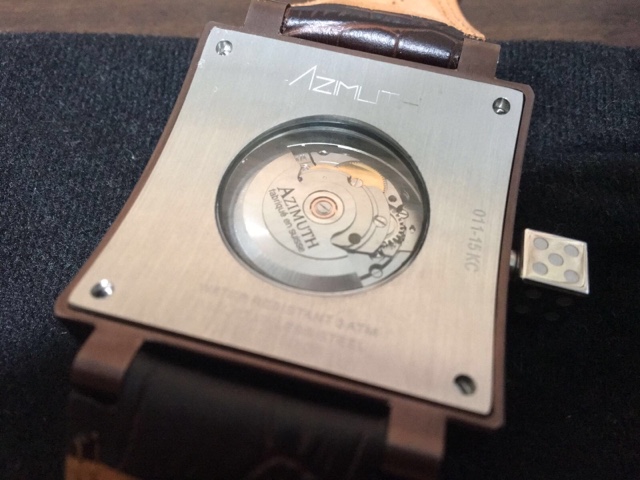

The SP-1 Casino-King is fitted with a modified self-winding Swiss ETA which has a pretty decent power reserve of forty hours. In terms of water resistance, it is resistant to a depth of thirty metres. In all honesty, I don’t foresee anyone carelessly wearing this to the pool for a dip. It is a little too cumbersome for that sort of activity.    


This watch is definitely flamboyant to say the least. It stands out in an innocuous but positive way, starting small conversations when you least expect with complete strangers. It certainly piques the interest and attention of people who cannot help but to ask for a closer look. Overall, this was a boldly conceived idea by the Azimuth team which seems to be a constant. It is surely a piece that may not appeal to all. This piece adds a little bit of excitement to the normalcy of everyday life.

Kudos to the Azimuth team for yet another marvellously bold piece. Thinking out of the box and always pushing watch designing to the next level.


Monday, September 14, 2015

Rado Voyager

Time to review another vintage piece, this time it is a Rado.

The Voyager has been a Rado model that has been around for a long time.

Strangely enough it is one of those models which has had different variations released along the years yet hardly any concrete info of it can be found online.

I have tried reading about it, to find out more of the story behind this piece but it is like looking for a needle in a haystack.

Just some back info on what shot Rado into “stardom”. Back in 1962, Rado produced the world’s first scratch-proof watch, the DiaStar, since then Rado set an industry standard in scratch proof watches and is still a market leader in scratch proof watches. Rado today still produces fine Swiss luxury timepieces, with multiple styles, having tough, sporty and timeless classic pieces as well.

Today we talk about the Voyager, which sounds somewhat like dive or boat watch or perhaps even to space, in reference to the term, “To voyage”.

As the golden age of space travel as set in the sixties, when Buzz Aldrin and Neil Armstrong set foot on the moon.

Voyager is the name of a model line by Rado, this particular model was around from the late 1960s towards the end of 1980s.

At the beginning, it was just one of many models. It did later it became s.th. like an entrance class model which was marketed for the Fareast markets.

There are countless variations of this piece. All have automatic day/date movements. This model was somewhat like a mass produced model, for the everyday man. There were literally tons of these watches by the end of the 1980s. The Voyager was in my own opinion and this may be true, was the most produced piece in their range.

With the never ending variations, the Voyager was more than just a model but an entire product range of one type of model.
For an everyday watch, it was a practical model and better yet, Swiss made and automatic as well.

For a piece which seems to be selling really well, it was a surprise it ended production.
Though if you think about it, it probably happened due to the Quartz Crisis back in the day.
So what did Rado tell me about my piece, they said

“Yours is from 1982 or later, inside should be an ETA 2836-2 automatic movement with day/date, as the first three digits of the reference number(636.xxxx.x). This movement came 1982. Snap on backs were usual at that time at Rado. From what I can see, it is completely authentic.

The water resistance is always a problem at vintage watches. If you want to have it waterproof, you need new gaskets for the back and crown and a hydrostatic test to be sure. That´s expensive. If you want to wear it regularly, you should have it serviced(cleaning, oiling, adjusting) by a good watchmaker.

Hope this helps. Enjoy it and wear it in health!”
 
I was ecstatic to know that I have yet another original vintage piece in my possession. Plus the last bit from their staff was kind of quirky, wear it in health!

For now this piece is kept in my collection, it is not a piece that I wear frequently as it is too small for my wrist, nonetheless it is a lovely piece that I love admiring.

If only they made the back case transparent or see through, that would have been brilliant.

As this was a widely produced piece, its price is somewhat challenging to discuss. What factors encompasses a Voyager worthy of a mentioning.

It all comes down to the same few factors for every piece I guess? The rarity, condition and current market demand. As we speak, there isn’t really a hype or excitement surrounding vintage Rado pieces except maybe the old DiaStars. Then again in about 10 years, the picture may be totally different?

You may come across many Rados online, especially on eBay. If you think it suits you and the price is right, why not go for it.

This is a nice piece to have for anyone beginning a collection. It isn’t something really fancy or pricy.

I see it as a quintessential piece that perhaps set the tone for automatic watches back in the 1960s, it was an everyday watch. It was somewhat like what our Seikos are today.

Below are some pics of my Rado, it is still in a fairly good condition.

The automatic movement works well and it can run well.


Condition perhaps 7.5-8 out of 10. There are some signs of wear on the face and some visible scratches


Monday, May 25, 2015

Valjoux, who?


One of the first movements that I began to hear a lot when I was reading up on timepieces and how many automatic watches ran was the term “Valjoux”.

It is one of the names I have heard many times and is a movement used in my timepieces, usually for chronograph movements.

Valjoux was a fabled movement maker and was part of the behemoth ASUAG group known today as Swatch Group.

The piece de resistance of the Valjoux movement is none other than the ETA 7750.

How this movement was conceived tells an interesting tale. At that time, Valjoux was a leader in the manual wind chronographs.

It had already produced the manual wind Valjoux 7733 movement which doing amicably well. In the 1970s, they wanted to spearhead a development of a new movement, one which would be reliable and cost effective. This movement is also acclaimed to be the first to have been designed with the aid of a computer back in the seventies.

Sadly it was short lived, it did sell well in the beginning with an estimated of around hundred thousand pieces in 1974. In the following year, production stopped and this movement went bust. At that time, the demand was so low that supplies lasted well into the eighties. Imagine if your Grandad or dad actually bought those pieces when nobody actually wanted them, they would have gotten them at a steal. Today you would be seating on a ‘goldmine’, as the demand for automatic timepieces were somewhat resurrected, so the ETA 7750, somewhat like the phoenix rose from the ashes. (Thankfully the people of ASUAG kept the dies and equipment so they could restart production seamlessly).

Thanks to its ingenious design, this was both durable and economical to produce, along with great support from Swatch Group the 7750 became the most movement in the Swiss automatic chronograph movement. It could be said to be the most successful automatic chronograph movement, perhaps period.

Here are some of the brands out that which use this fantastic movement in the timepieces; Breitling, Cyma, Hamilton, IWC, Mido, Omega & Panerai to name a few.

Wednesday, April 15, 2015

My Bulova Sea King


I recently got my hands on a classy vintage Bulova Sea King, fitted with a Speidel elastic band.

This was a particular model that I have been trying to get my hands on for a while, pictures below.


Prior to getting it, all I knew that it was from the era of the seventies but its story, which once I found out which intrigued me and made me sought after this piece even more.

So when I got it, the first thing I had to do was to get it authenticated from Bulova (something everyone should do once they get any vintage watch).

So Bulova got back to me, confirming my time piece was indeed genuine and from the N1 on the back case confirmed that it was produced in 1971.

Wow! What a marvellous piece of work, it is 44 years old this year and it still works fine.

From what I have gathered, the Sea-King was a water-resistant line from Bulova, it was introduced in 1959 all the way till the seventies. Which means mine was one of the later models.

Some have only the label “SEA KING“, some with the “SEA KING” & Whale logo, while some only had the whale. Which I guess changed over time. This is what is believed as a general consensus.

It seemed to be something that was not questioned by most, who took it as a gradual change in the aesthetic feature of the watch. Apparently there is a meaning to the whale on the face.

Some Bulova experts, have stated that the whale actually appeared around the 1966 to 67 but it did not necessarily meant it was a ‘SEA KING’ model. The whale actually meant it was waterproof.

If you dig further, there seem to be a link or a tribute to the Whalers of Sag Harbour, which was the home of the Bulova watch case factory (at Sag Harbour).

We only know this to be hearsay, its seems plausible thought. The whale logo came out around 1966, which coincidentally marked the 100 year anniversary of a Whaling Festival of Sag Harbour which was where the Bulova factory was situated as well. This seems the most promising explanation which links the two together.

For those of you who would like to delve deeper, have a whale of a time reading more into the story here : http://www.mybulova.com/forums/bulova-sea-king-whale

I guess the story of the watch actually compelled my to want to own one as well, as it has an interesting story shrouded in mystery.

I am a fan of many of the old Bulova timepieces, another highly sought after piece for myself would be the Bulova Accutron.

To me, the Bulova timepieces of old which were Swiss made are really lovely and has that ‘real deal’ feel about it. What I mean is that it built watches that were made to last.

Though the current modern day do Bulovas look nice and are now mostly made in Japan, I am just a little unsure if it would stand the test of time, like the stalwart Sea King that is still going strong 44 years on.  Asthetically a watch may look exquistie but there more than meets the eye. To someone who love timepieces, the movent and detailing matter much as well.

Though I would think it would be time I sent it for some general servicing and cleaning.

As to why it is now mostly manufacuted in Japan, here is a short history.

Back in the day, Bulova was a major force in the watch industry. Bulova timepieces were mechanical movemnts that were well made, deisgned and relialbe (just look at the one I got, still ticking away). Bulova had a great share of the electronic watch market with their tuning fork Accutron. By the mid seventies, there was an eruption of quartz watches in the market, Bulova was suddenly hit and somehow seemed to dwindled down from then. It has lost its marketshare to the influx of Japanese watches, names the qaurtz watches. They were sold to the Loewe Corporation and then finally sold of to Citizen of Japan in 2007.
 
So the Sea King is surely a piece to be etched in Bulova history.

Deconstructing the Tachymeter


Alright today let’s talk about the tachymeter complication.

A tachymeter gives a timepiece a sporty look, something that when you look you associate with sports such as racing or for the military.

It add lovely contrasts to many timepieces, making the overall look more sophisticated.

Though a lovely complication which adds dimension to your timepiece, it may be totally foreign or alien to some on how to use it.

Like seen from the below picture, my Seiko Criteria SNDG13P1 (which I will write about soon)


Some people go out having their timepiece without ever using the tachymeter function.

To a major share of watch uses, they may simply purchase a timepiece with the tachymeter function due to the fact that it add aesthetic value to their timepiece.

So let us cover how a Tachymeter actually works.

A tachymeter scale is a scale sometimes inscribed around the rim of an analogue watch. Usually with Arabic marking around the dial as well.
 

This function is used to either measure a distance based on speed or speed based on travel time. The markings have spaces in between them on the tachymeter dial are consequently proportional to 1/t where ‘t’ is the elapsed time.

A tachymeter’s performed function is independent of the unit of distance be it kilometres, miles or any other only as long as the unit of measure is equivalent for all calculations. In essence, a tachymeter is a way or means of converting ‘elapsed time in seconds per unit to units per hour’.

To get a little mathematical below is some info on calculations to work it out;

“To use a tachymeter function to measure speed, start the chronograph at a starting marker of a known distance. At the next position, the point on the scale adjacent to the second hand indicates the speed of travel between the 2. The typical scale on a timepiece converts between the number of seconds it takes for an event to happen and the number of times that event with occur in a hour. The formula to create this

kind of tachymeter scale is     T = 3600/t   

Where ‘T’ is the tachymeter scale value and ‘t’ is the time in seconds that it takes for the event to occur and ‘3600’ is the number of seconds in an hour.

So lets work out an example, if it takes 35 seconds to travel 1 kilometre then the average speed would be 103KM per hour. Do take note that the tachymeter scale only calculates the average speed.”

So with that, we are more or less through with the practical of a tachymeter.

Lastly, just some history, the first rotating bezel tachymeter was introduced by Heuer, now Tag Heuer which was back in 1958.

By the late sixties chronograph timepieces where sky rocketing, demand grew invariably and watch manufacturers around the globe were contesting to opportunities to patent automatic versions and wanted exclusive rights. It has to be known that without the chronograph the tachymeter complication would have no place as well.

Let me share a little fascinating history on some very lovely chronograph movements which came into being.

Around that time Breitling, Heuer and Hamilton partnered up with Dubois Depraz to develop the first ever self-winding chronograph. It was a clandestine affair in which only a handful of professionals involved on a need to know basis. This great development was unveiled in Geneva and New York on 3rd of March 1969. Called the Chrono-matic, the Calibre 11 movement would wind itself using an off centre micro rotor.

Soon enough, Zenith had produced the El Primero (Which might I add, is absolutely stunning!) which used a central mounted full rotor and was capable of measuring time to one tenth of a second.  Seiko the Japanese giants also released their automatic chronograph called the 6139 Auto-Chrono.

Out doing themselves once again, Seiko created the world’s first quartz watch, a giant breakthrough in Horological history, thanks to this hefty invention it somewhat marked an end and seemingly rendered chronographs virtually obsolete with the Seiko Quartz Astron 35SQ.

Back to our modern day and age, the chronograph is making a comeback and is appreciated by many once again.

With many lovely pieces from Tag, Seiko, Breitling, Hamilton and so on.

Though some of us may not entirely know how it functions or its practicality, it may serve as an aesthetic feature. Nonetheless the tachymeter is a lovely complication, you will never know when it may come in handy.